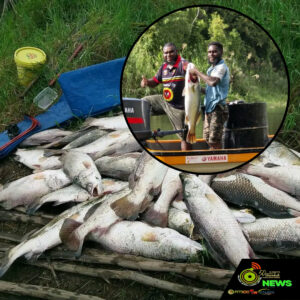
EPIC JOURNEY OF WESTERN PROVINCE’S BARRAMUNDI- River to Sea and Back
BY KENNY ROMANUS
THE iconic barramundi, the largest and most highly valued fish in Western Province, is central to one of the region’s most extraordinary natural cycles, a migration that spans hundreds of kilometres along the Fly River system.
For generations, river communities have understood what scientists have since confirmed: barramundi begin life in coastal saltwater before moving upstream into freshwater rivers, lakes and swamps where they grow to maturity. Their life cycle is closely linked to the monsoon season and the vast river networks that shape the province.
Each year, mature barramundi travel from inland waters such as the Strickland River and Lake Murray downstream to coastal spawning areas near Sigabaduru village, west of the Fly River mouth. This downstream migration typically starts in the months leading up to the monsoon, between September and November.
Research involving tagged fish has recorded remarkable journeys of up to 622 kilometres between freshwater habitats and the sea.
Spawning activity reaches its peak from November through March, when adults release their eggs in high-salinity coastal waters. After hatching, larvae are transported by tidal currents into mangrove-lined nursery grounds, where they remain for up to six months before gradually shifting into brackish creeks and freshwater systems.
By their first year, young barramundi have entered inland rivers and floodplains, where they will spend several years feeding and growing.
Barramundi are euryhaline, meaning they can survive in both saltwater and freshwater environments. This adaptability enables them to transition smoothly between marine and inland ecosystems.
Males usually reach maturity at three to four years of age, measuring about 50 centimetres. At around seven years old, many change sex to become females, growing up to one metre in length. These large females play a vital role in sustaining breeding populations.
Young barramundi feed mainly on zooplankton, while adults prey on crustaceans, molluscs and smaller fish, sometimes even other barramundi.
Recently, visiting divers reported finding a submerged tunnel in the Agu River between Mipan and Manda, which they suspect may serve as a migration pathway. Residents of Manda say barramundi had not been seen in their waters for several years, sparking concern among local fishers.
Chris, a fisherman from Manda, said barramundi were once commonly caught there using nets, and the newly discovered underwater passage could help explain shifts in the species’ movement patterns. Although scientific verification is still required, the report has renewed community interest in better understanding and safeguarding the species.
Across Western Province, barramundi remain both economically significant and culturally valued. However, the fishery has faced serious challenges in the past.
Intensive harvesting during the 1980s caused a severe decline in stocks. Annual commercial catches dropped from over 200 tonnes to just four tonnes by 1990.
In response, a fisheries management plan was enacted in 2003, aimed at protecting juvenile fish and large breeding females. Measures include restrictions on gill-net mesh sizes for artisanal fishers, along with hatchery and restocking programs to help rebuild populations within the Fly River system.
Specialists caution that spawning groups gathering near Sigabaduru between October and November remain especially vulnerable to overfishing.
From the coastal waters of South Fly to the inland swamps of Middle Fly, barramundi complete one of the region’s most impressive migrations, swimming vast distances against powerful currents to reproduce.
For the people who live along the Fly River and its tributaries, conserving barramundi is about more than sustaining a commercial resource. It is about protecting a livelihood and cultural identity deeply connected to the river’s seasonal rhythms.
As research advances and conservation efforts continue, the long-term survival of Western Province’s prized barramundi will depend on striking a careful balance between traditional knowledge, scientific insight and responsible management.